





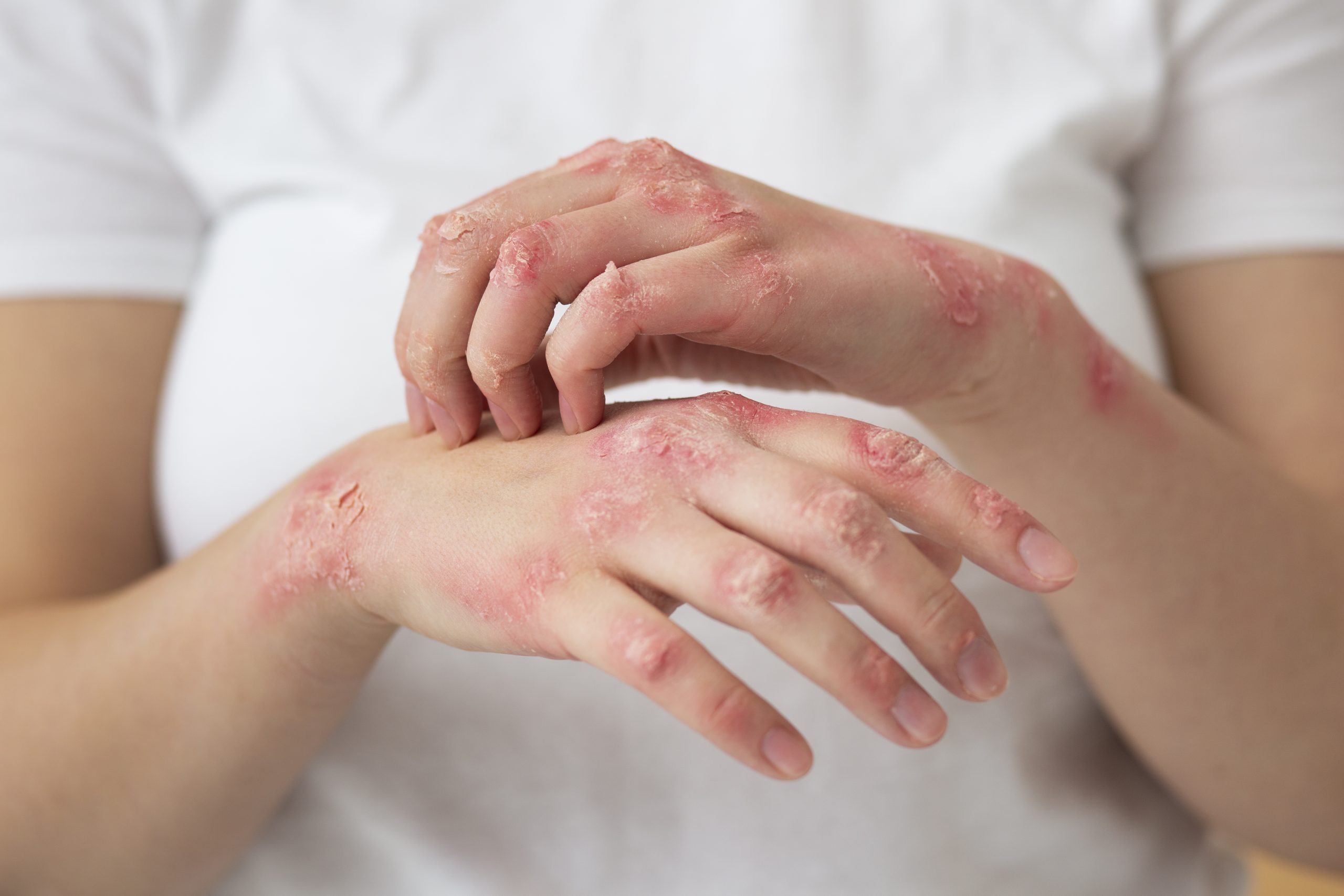
Learn what psoriasis is, how common it is, whether it’s contagious, key triggers, symptoms, and evidence-based treatments—from topical care to phototherapy and biologics.
What is psoriasis?
Psoriasis is a chronic inflammatory skin disease in which skin cells divide faster than normal, causing thick, inflamed patches. It can appear in several forms; the most common type presents as well-defined, raised red plaques covered with silvery-white scales—the origin of the term “psoriasis.”
How common is psoriasis?
It occurs in all ethnicities, with a worldwide prevalence of about 1–3 in 100 people. Men and women are affected equally. It can occur at any age, but most cases begin between ages 20 and 40.
Is psoriasis contagious?
It is not caused by an infection and cannot be transmitted. Close contact with someone who has psoriasis is safe. While the exact cause is not fully understood, multiple factors contribute. Current medical evidence recognizes psoriasis as an immune-mediated inflammatory disease, with genetics as a key underlying factor along with internal and external environmental triggers.
1. Genetic factors
These are the primary underlying factors, but having one affected family member does not mean others must develop the disease. Only about one-third of patients report a family history.
2. Immune factors
In genetically predisposed individuals, immune responses trigger inflammation. The skin is the main organ that shows disease activity.
3. Disease triggers
Each patient has a different sensitivity to triggers. Patients should observe their own flares and avoid triggers whenever possible to improve control.
- Internal illnesses and some infections, such as certain bacterial or viral infections.
etc.
- Mental health and stress strongly influence symptoms. Stress, irritability, anger, and insomnia often precede flares, increasing redness and itch and prompting scratching that worsens the condition.
- Hormonal fluctuations, such as during menstruation, pregnancy, or after childbirth.
- Certain medications, e.g., beta-adrenergic blocking agents for hypertension, hydroxychloroquine (antimalarial), lithium, and some herbal remedies.
- Skin injury: scratching, rubbing, friction, sunburn, insect bites, and irritation from harsh cleansers or strong acids/alkalis.
- Other factors such as smoking and alcohol.
Will psoriasis go away?
Psoriasis tends to wax and wane, with flares and remissions. With appropriate treatment and trigger avoidance, symptoms can remit or become less severe.
What are the symptoms of psoriasis?
Manifestations vary by type, symptoms, body sites, lesion size and distribution, and chronicity.
1. Skin symptoms
Rashes appear in several forms. Commonly, there are well-demarcated plaques with silvery-white scales; removing the scales may reveal pinpoint bleeding. Some patients experience itching. Lesions can occur anywhere; typical sites include elbows, knees, sacrum, scalp, and limbs.
Some patients have chronic eczematous-like inflammation. Other patterns include widespread small red papules or generalized redness with pustules, which may be acute and accompanied by fever and myalgia.
Healed plaques usually do not leave scars, and hair loss is rare. However, temporary changes in skin color at prior lesion sites can occur and gradually fade over time.
-
Psoriasis of the fingernails and toenails
Many patients have nail abnormalities, ranging from small pits and thickening with subungual debris to onycholysis and nail dystrophy.
-
Psoriasis of the joints and tendons
Inflammation of joints and entheses occurs in about 10–30% of patients. Joint symptoms often follow skin disease and can involve distal interphalangeal joints, elbows, knees, and the spine. Without proper care, long-term joint damage and deformity may result.
Is psoriasis dangerous to the body?
Average life expectancy is similar to the general population. However, studies show an increased incidence of metabolic syndrome—including diabetes, obesity, hypertension, and dyslipidemia—which raises the risk of atherosclerotic cardiovascular disease.
How is psoriasis treated?
Because psoriasis is chronic, the main goal is disease control—skin and joint symptoms—with minimal side effects. Combination and rotational therapy are often used. Plans are individualized based on severity, triggers, mental health, attitude toward disease, occupation, sex, and age.
Topical treatments
-
Emollients and moisturizers
Keeping skin well-hydrated reduces itch and burning, discourages scratching, and enhances penetration of other topicals. For best results, apply immediately after bathing while the skin is still slightly damp and reapply during the day. Choose gentle, non-irritating, fragrance-free products with low allergy risk (hypoallergenic).
-
Topical corticosteroids
These are the most widely used treatments. Lotions or shampoos suit the scalp; low-potency creams are preferred for the face and flexures. Incorrect use, especially prolonged use of high-potency steroids, can thin the skin; systemic absorption can suppress the adrenal axis. Long-term or extensive use should be supervised by a dermatologist.
-
Coal tar preparations
Used for many years in shampoos, creams, lotions, and ointments. Tar shampoos remain popular and effective for scalp psoriasis, though odor can be strong. Possible side effects include skin irritation.
-
Vitamin D analogs (calcipotriol)
Effective at reducing plaque thickness and often combined with steroids. Common side effect is local irritation. Excessive use may raise calcium levels, so medical supervision is advised.
-
Other topicals
Include calcineurin inhibitors, anthralin (dithranol), and salicylic acid.
Phototherapy and laser treatment
Used alone or in combination. Patients typically require treatment at least twice weekly. Common options include narrowband UVB, PUVA (UVA with psoralen), and PUVA with retinoids. Laser options include the excimer laser.
Oral and injectable treatments
Indicated for moderate to severe disease and for psoriatic arthritis/enthesitis. Options include methotrexate, retinoids, and cyclosporine. Newer injectable biologics are highly effective but costly. Because many of these suppress the immune system, strict medical supervision is essential.
Self-care for patients with psoriasis
- Apply moisturizers regularly to relieve dryness; use mild, non-irritating cleansers.
- Avoid alcohol and smoking.
- Manage stress and support mental well-being.
- Maintain overall health with exercise and adequate sleep.
- If overweight or obese, lose weight and screen for metabolic syndrome.
- If you are taking oral or injectable immunosuppressive medicines, follow your doctor’s instructions strictly. Do not self-medicate when ill, as drug interactions may occur. Seek medical care promptly if you develop a fever.