





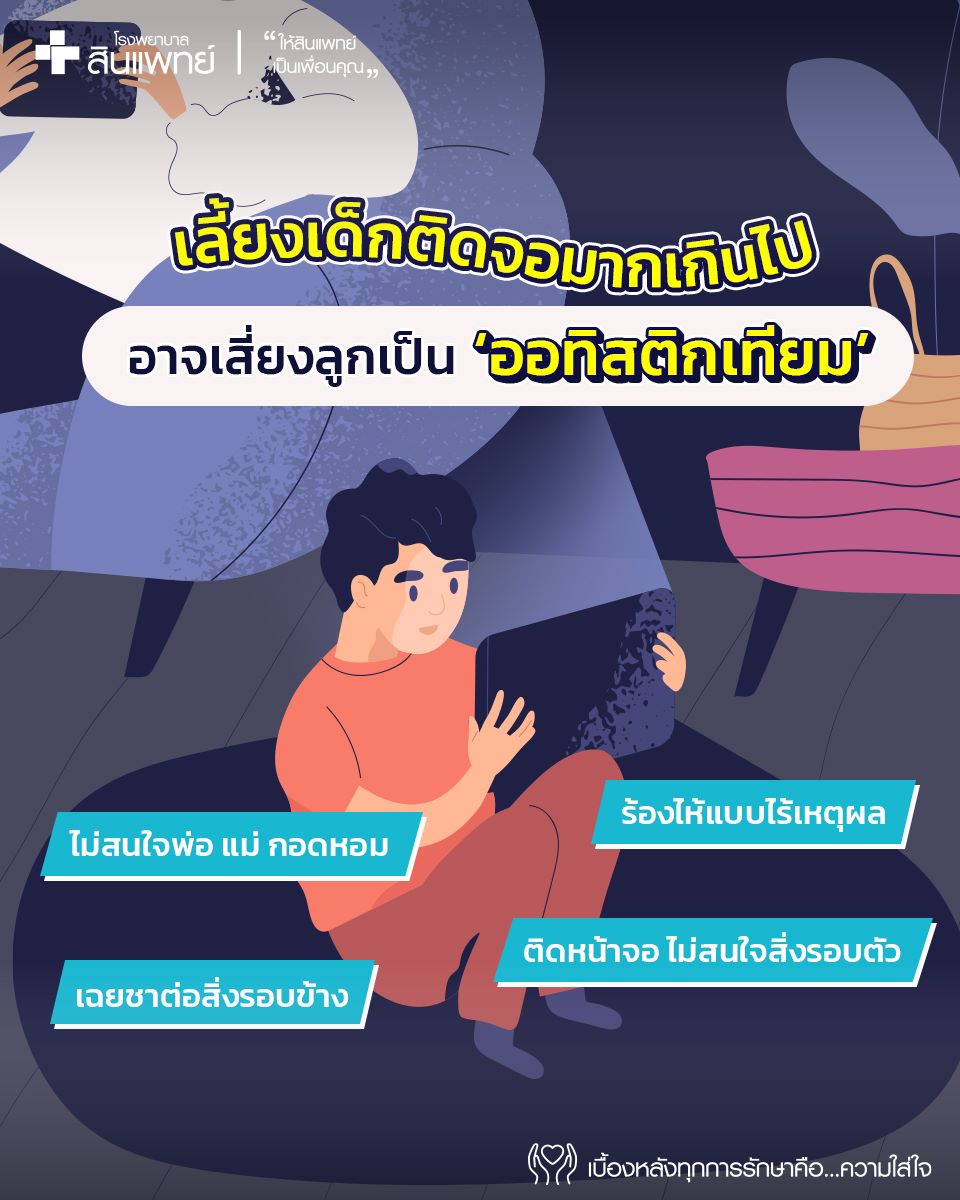
Excessive Screen Time in Children May Increase Risk of “Pseudo Autism”
What Causes Pseudo Autism?
Pseudo Autism occurs due to lack of proper developmental stimulation during childhood. When parents neglect interaction or allow children to spend too much time on smartphones and tablets, children receive one-way information and lack two-way communication stimulation, resulting in delayed communication and social interaction difficulties.
Symptoms of Pseudo Autism
Symptoms of pseudo autism resemble true autism but differ in development and response to therapy. Those with pseudo autism often show the following signs:
- Difficulty adapting to play with other children due to limited shared interests
- Avoidance of eye contact, communication problems, and emotional expression issues
- Unable to express needs, resulting in tantrums or crying without clear reasons
- Limited meaningful speech or slow speech if able to speak
- Inability to separate from communication devices such as smartphones or tablets
However, these symptoms typically appear after emotional trauma or sudden environmental changes, unlike true autism which presents symptoms from early childhood.
Treatment for Pseudo Autism
Treatment of pseudo autism requires cooperation from multiple parties and involves various approaches:
- Children under 2 years should avoid all screen media; children over 2 years should limit screen time to no more than 1 hour per day
- Engage in frequent communication to promote two-way interaction
- Train children to make eye contact during conversations and stimulate developmental activities
- Encourage social interaction with peers to improve social skills
Technology has advanced greatly, making electronic media easily accessible, even for young children. Busy parents sometimes rely on screen media as a companion for their children, believing it helps early learning and language skills. Common screen media include TVs, smartphones, and tablets. However, improper and excessive use, such as prolonged solo cartoon watching without supervision, can cause developmental and behavioral issues, including pseudo autism-like behaviors.
Autism is a neurodevelopmental disorder affecting social and language skills, caused by multiple factors. In contrast, “pseudo autism,” commonly misunderstood and not a medical diagnosis, results from lack of interaction and communication stimulation, such as excessive screen time, leading to delayed language development and social interaction skills.
Children with pseudo autism exhibit behaviors like not speaking, not imitating adults, lack of interest in surroundings, inability to play with others, ignoring others, crying when not allowed screen time, and attachment to devices even when parents try to comfort them. Left untreated, these children may experience developmental delays compared to peers.
If parents notice signs of pseudo autism, they can bring their children for assessment at the Child Development Center, Pediatric Department, Synphaet Lam Luk Ka Hospital>> Click here for evaluation and age-appropriate developmental support. Ideally, parents should promote natural learning and social interaction to foster proper development.
Prevention of Pseudo Autism
Prevent pseudo autism with these four key strategies:
- Limit screen time: Children under 2 years should not watch TV, smartphones, or tablets. Children aged 2-5 years should limit screen time to no more than 1 hour daily with close adult supervision.
- Promote activities and interaction: Encourage developmental activities, ideally with others, such as reading, coloring, singing, and outdoor play.
- Create a positive environment: A supportive environment encourages appropriate development. Parents should regularly talk with children, teach vocabulary, and stimulate self-expression.
- Observe development closely: Monitor children carefully and seek professional advice if any abnormalities are noticed.
Differences Between Pseudo Autism and True Autism
Differences can be observed through these factors:
- Cause: True autism originates from brain abnormalities, while pseudo autism results from inappropriate upbringing such as excessive screen time.
- Development: True autism shows continuous developmental impairments without progress; pseudo autism shows delayed development but can improve with correct intervention.
- Communication: True autism has significant social difficulties and requires special education; pseudo autism also has social challenges but less severe.
- Behavior: True autism features repetitive behaviors and restricted interests; pseudo autism behaviors are less distinct and adaptable.
Impact of Pseudo Autism on Children and Families
Pseudo autism affects children with developmental delays, adaptive and learning difficulties, especially in language and social skills, and behavioral issues such as irritability or aggression, eventually leading to social withdrawal and developmental deficits. Parents may experience worry, financial burden, stress, and family conflicts.
With care, Dr. Chutimon Kongsamrit #ChildDevelopmentCenter #PediatricsDepartment #SynphaetLamLukkaHospital
For more information, call 02-006-9999 or
Add Line ID: @synphaetline
#SynphaetLamLukkaHospital
#SynphaetYourFriend
#CareBehindEveryTreatment