




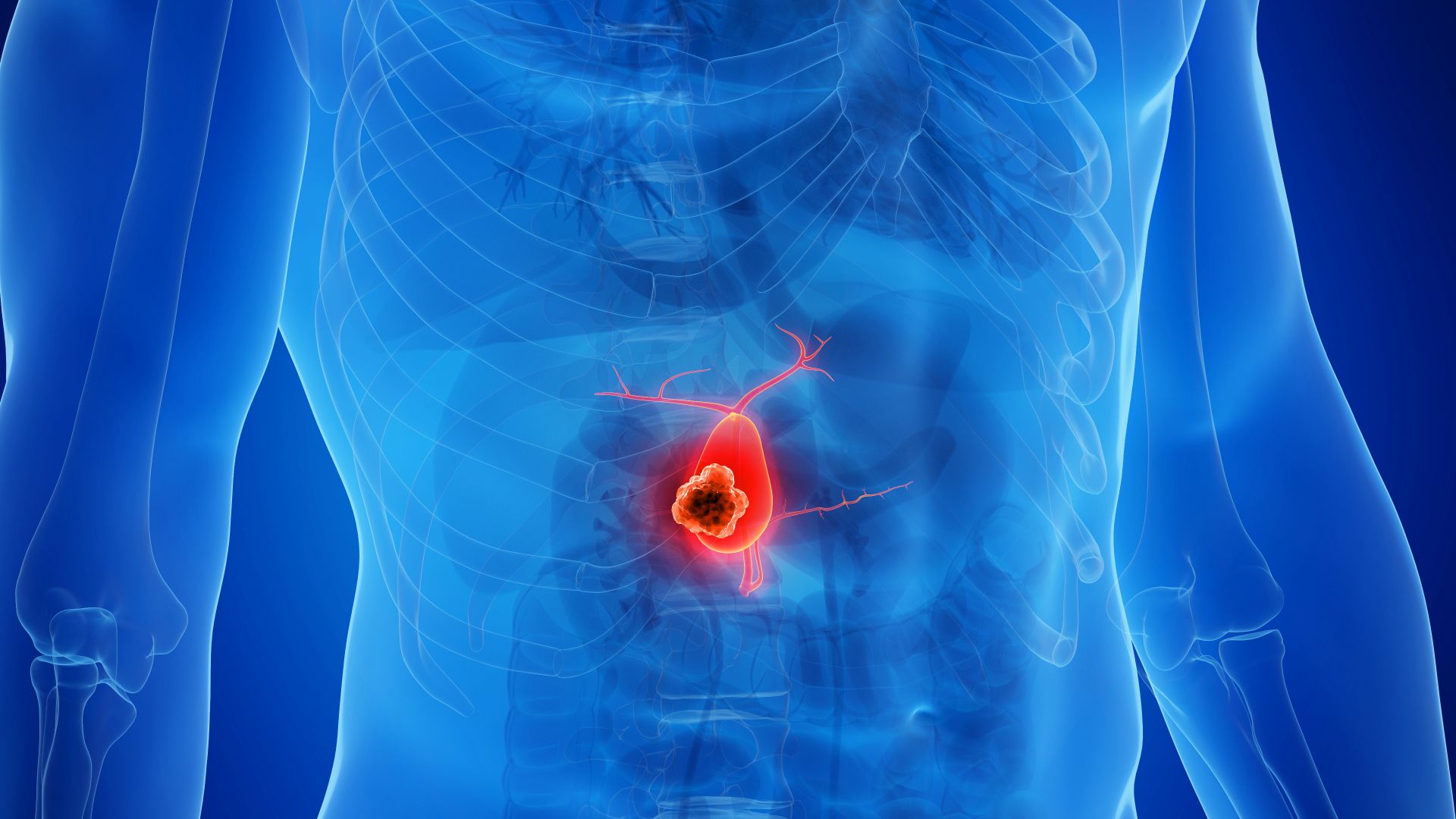
Gallbladder Cancer is a malignancy caused by abnormal cell growth in the gallbladder
The gallbladder is an organ responsible for storing and releasing bile to aid in fat digestion. Although gallbladder cancer is relatively rare, it is highly aggressive because patients often show no symptoms in the early stages. As a result, most patients are diagnosed when the disease has already progressed.
What are the risk factors for gallbladder cancer?
The exact cause of gallbladder cancer is still unknown, but several factors have been associated with an increased risk of developing the disease, including:
- Gallstones – the most important risk factor; approximately 75–90% of gallbladder cancer patients have gallstones.
- Chronic gallbladder inflammation – long-term inflammation can cause changes in the gallbladder lining cells that may eventually develop into cancer.
- Gallbladder polyps, especially those larger than 1 centimeter.
- Bile duct abnormalities, such as congenital bile duct dilation.
- Liver fluke infection.
- Women are affected about 2–3 times more often than men.
- Older age (65 years and above).
- A family history of gallbladder cancer.
What are the symptoms of gallbladder cancer?
In the early stages, patients often have no symptoms. The condition may sometimes be discovered incidentally during an abdominal ultrasound. Symptoms usually appear when the disease has already progressed, including:
- Abdominal pain, usually in the upper right abdomen or below the sternum, often chronic.
- A palpable lump in the abdomen under the right rib cage.
- Jaundice (yellowing of the skin and eyes) and itching caused by bile duct obstruction.
- Unintentional weight loss.
- Loss of appetite, nausea, and vomiting.
- Low-grade fever.
How is gallbladder cancer diagnosed?
- Blood tests to evaluate liver function and tumor markers such as CEA and CA 19-9.
- Radiological imaging.
- Abdominal ultrasound, which is usually the first test used to detect abnormal masses.
- CT Scan or MRI/MRCP to evaluate tumor size, extent of invasion, and possible metastasis.
- PET Scan to assess cancer spread.
- Endoscopic Retrograde Cholangiopancreatography (ERCP) to identify bile duct obstruction and obtain tissue samples for pathological confirmation.
How is gallbladder cancer treated?
Treatment depends on the stage of the disease and the patient’s overall health. Treatment approaches include:
- Surgery – the only potentially curative treatment if the cancer has not spread. In early stages, removal of the gallbladder alone may be sufficient. If the cancer has advanced, partial liver resection and lymph node removal may also be required.
- Adjuvant therapy
- Chemotherapy – used when surgery is not possible or after surgery to reduce the risk of recurrence.
- Radiation therapy – often combined with chemotherapy when the tumor cannot be completely removed surgically.
- Palliative care – for advanced-stage patients who cannot undergo surgery, such as bile drainage to relieve jaundice and symptomatic treatment.
Prognosis of gallbladder cancer
If gallbladder cancer is detected at an early stage, the 5-year survival rate may reach 50–80%. However, if diagnosed after metastasis has occurred, the survival rate drops significantly (<5%), as this cancer often spreads to the liver easily.
How can gallbladder cancer be prevented?
- Treat gallstones – patients with symptomatic gallstones should undergo gallbladder removal surgery. For asymptomatic patients with high-risk features such as large stones > 3 centimeters, surgery and pathological examination of the gallbladder may be recommended to detect early-stage cancer.
- Maintain a healthy weight and consume a high-fiber diet to reduce the risk of gallstones.
- Have regular health check-ups. If gallstones or gallbladder polyps are detected on ultrasound, regular monitoring is recommended.